The Coverage Calendar Belongs in Your Forecast
Soft Q4 often looks like demand failure. It is usually permission failure.
The Boomerang | Issue 42
The Coverage Calendar Belongs in Your Forecast
You are not forecasting demand. You are forecasting permission.
The Signal
Here is the bite for leaders.
Most Q4 forecasts are still demand stories. The market is running permission stories. Champions, demos, and "interest" still fill the CRM. Permission gates fill the hospital. When those two calendars diverge, the number softens and everyone calls it "committee delay."
That is not bad luck. That is a design choice.
If Market Access owns the CMS memo and Sales owns the stage names, you are running two calendars against one quota. The quota loses. The competitive move this quarter is not reading CMS first. It is forcing permission into stage exit criteria, account sequence, and commit language before your competitor does.
The next 90 days make that visible. CMS coverage and payment clocks sit on the same sheet as your Q4 number. They decide which accounts can actually buy, which conversations are early, and which "commit" deals are theater.
This is not a structural-heart essay. Structural heart only made the pattern public.
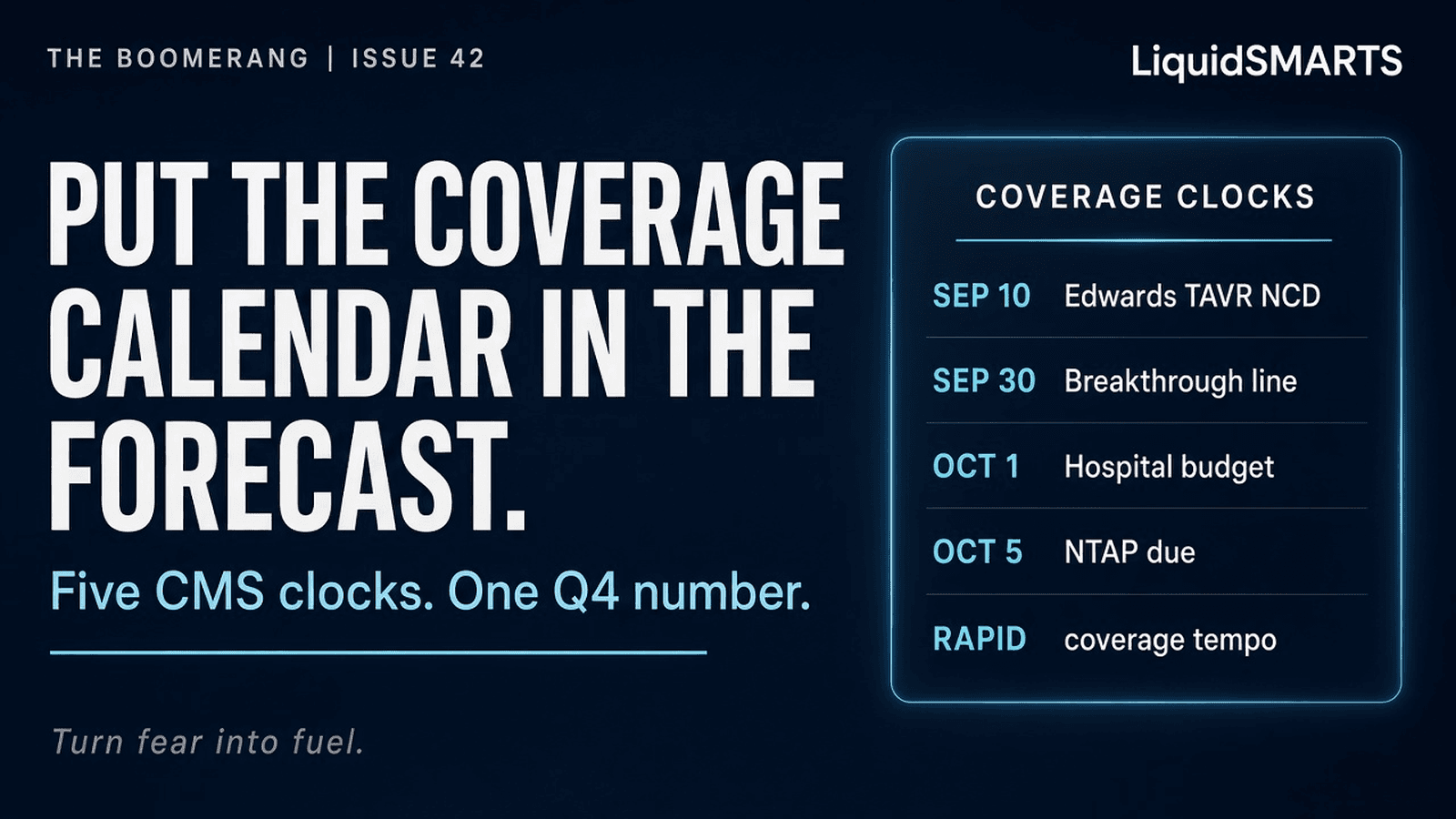
Named proof one: Edwards and the TAVR rewrite. On September 10, CMS finalized new national coverage rules for TAVR. Coverage with evidence development is gone for symptomatic severe aortic stenosis. Asymptomatic severe disease stays under CED. Heart-team and volume rules eased, but they did not vanish. Edwards said 2026 guidance is unchanged and implementation will take time. That is a permission-map change with a company name on the earnings call.
Named proof two: Breakthrough by September 30. Under the FY2027 IPPS settlement, Breakthrough Device designation by September 30, 2026 can still decide who keeps a limited alternative path into NTAP and outpatient pass-through for FY2028 and FY2029. If launch math assumes that path, the designation date is a commercial date.
Named proof three: NTAP due October 5. CMS set Monday, October 5, 2026 at 5:00 p.m. ET as the FY2028 new technology add-on payment application deadline in MEARIS. If add-on payment is in the launch story, packaging and account sequence share one plan.
Named proof four: RAPID across categories. In April, CMS and FDA announced RAPID for eligible Breakthrough devices: a proposed NCD on the same day as FDA authorization, with final coverage targeted in weeks, not a year. Tempo changed for any franchise that qualifies.
Named proof five: October 1 in the hospital. The payment-year turn still gates capital and procedure boards. That clock hits every inpatient franchise, not only valves.
Read the proofs as one leadership sentence: coverage timing is territory timing, because permission is what the forecast should have been measuring all along.
At LiquidSMARTS℠ we have said for years that Clinical, Operational, and Financial value have to travel together. Coverage is how Financial value gets permission to appear in the account. Leaders who leave that permission outside the forecast are managing activity. Leaders who put it inside the forecast are managing reality.
The Mechanic
1. Demand stages lie when permission moves
A warm champion is not an open pathway. A completed demo is not a budget board. A "verbal yes" is not credentialing.
After a coverage rewrite, the clinical story can look unchanged while the hospital's permission structure changes: who must be in the room, what volume history matters, which pathways open without extra friction, how long credentialing takes before case one.
That is why forecasts drift. Stage names stay clinical. The real gate is permission. Teams keep scoring demand. Hospitals keep gating on rules, capacity, and money timing.
Edwards already modeled the honest version for TAVR: easier coverage, unchanged guidance, implementation lag. Any franchise that treats "coverage got better" as automatic volume is making the mistake Edwards refused to make in public.
2. Two calendars produce one soft number
Market Access tracks NCDs, LCDs, NTAP, Breakthrough, RAPID. Sales tracks pipeline stages. Finance tracks commit.
If those three reviews do not share one coverage calendar, you will keep a clean story and a dirty number. The field will feel it as stalled deals and "surprising" committees. Leadership will feel it as a Q4 rewrite in November.
The informed actor sees the design flaw: permission was treated as background. It is foreground.
3. The advantage goes to whoever rewrites exit criteria first
Reading the memo is table stakes. The bite is operational:
- Stage exit criteria name a permission gate, or the stage is invalid.
- Commit language separates open-now from open-with-a-plan from theater.
- Account sequence follows which clocks opened, not which champions answered email.
That is how coverage timing becomes territory timing. Not as a slogan. As a ranking rule.
4. Packaging deadlines are competitive weapons
Breakthrough designation lines and NTAP due dates are not reimbursement trivia. They decide whose launch story can include add-on payment and whose cannot. RAPID compresses the gap between authorization and coverage so commercial planning has to start earlier. October 1 decides which capital conversations are still alive.
Leaders who leave those dates in a HEMA folder hand the sequence advantage to whoever puts them on the opportunity sheet.
The Move
These are decisions for a commercial leader and the informed operators around them. They are not a research project. Do them this week.
Decision 1. Name the insight in the room
Open the next opportunity review with one sentence:
"We forecast permission, not interest."
If someone argues that coverage is Market Access's job, you have found the design flaw. Keep the sentence on the board for 30 days.
Decision 2. Make permission an exit criterion
Pick your top three stages before commit. Rewrite exit criteria so each stage names a permission proof, for example:
- pathway clear under current NCD/LCD language,
- credentialing or privilege path dated,
- budget board timing known relative to October 1,
- add-on payment story packaged or explicitly not required.
If a deal cannot show the proof, it cannot advance. No exceptions for "great champion."
Done this week when: stage definitions are rewritten and visible to first-line managers.
Decision 3. Re-rank commit on permission readiness
Take the commit and upside list. Force every deal into one of three piles:
- Open now: permission clear enough to pursue this quarter
- Open with a plan: coverage helps, but a dated implementation gate remains
- Theater: warmth without a survivable committee or budget path
Move theater out of commit in the same meeting. Do it in public. The bite is the re-rank, not the taxonomy.
Decision 4. Put one coverage calendar on the commercial review, not a side meeting
Build a one-page calendar with only the clocks that hit your book. Use the named national clocks when they apply (Sep 10 TAVR NCD, Sep 30 Breakthrough line, Oct 1 hospital budget, Oct 5 NTAP, RAPID milestones), then add your LCD and franchise-specific gates.
Owner: one commercial leader, with Market Access as input, not as a separate audience. The calendar opens the opportunity review. It does not live in a HEMA-only forum.
Decision 5. Change the coaching question company-wide
Replace "How did the clinical meeting go?" with:
"Which permission gate on our calendar still has to move before this account can buy?"
First-line managers ask it on every deal above threshold for two weeks. Leaders audit two calls each and coach to the gate, not the charm.
Decision 6. Spend political capital on five accounts
Choose five deals where permission, not product, is the bottleneck. Sales and Market Access produce a half-page each: decision rights, remaining proof, realistic first-case or PO date. Bring all five into the same review. Use them to teach the system, then scale.
What the informed actor takes away
- Insight: Q4 softness often looks like demand failure. It is usually permission failure wearing a demand costume.
- Design flaw: Two calendars (coverage vs stages) against one number.
- Advantage: Whoever rewrites exit criteria and re-ranks commit first turns coverage timing into territory timing.
- This week's proof: Theater deals leave commit; permission proofs enter stage exits; one shared calendar opens the review.
Edwards already told the market that easier coverage is not automatic volume. Leaders who install that honesty into the forecast will feel steady. Leaders who celebrate the memo and keep demand stages will rewrite Q4 later.
Coverage timing is territory timing because permission is the product the hospital actually buys before it buys your device.
Put the calendar in the forecast. Put permission in the stage. Put theater out of commit.
LiquidSMARTS℠ works with medtech commercial teams on pipeline velocity with a clear 90-day frame. The starting point is usually one honest opportunity review that forecasts permission, not interest.